Showing posts with label Sealants. Show all posts

Applying sealants

Sealants (apart from brushable types) are applied using a caulking gun, which can take a little practice to use properly. Before putting the cartridge into the gun, the tip tube may need to be cut off to allow the sealant to be forced into the nozzle. Once this is done, screw the nozzle back onto the tube then clip off the end of the nozzle at a 45-degree angle, using a sharp utility knife. The further down the nozzle you cut it, the larger the bead of silicone that will come out. If you only need a very fine bead, clip it off quite close to the tip as it’s
always easy to make the bead larger if required.


Slide the handle of the caulking gun all the way back, then slip the tube into place before pushing the handle of the gun in until it stops against the plug in the end of the tube.


To apply the silicone, turn the handle and then firmly apply constant pressure to the trigger until the silicone starts to flow out the end of the nozzle. To stop the flow, turn the handle until the pressure is released.


There are two ways of applying silicone – either ‘pushing’ the bead in front of the nozzle or ‘pulling’ it behind the nozzle. Try and produce an unbroken bead of silicone but, if necessary, smooth it out with a filling knife.
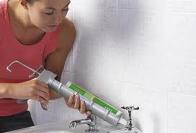


To create a tidy job, apply masking tape to both surfaces, creating a ‘valley’ where the silicone can be applied. As soon as the silicone has been applied, remove the masking tape. Alternatively, spraying the area with a fine mist of soapy water allows any excess sealant to be cleaned up effortlessly.

Sealants

There is a wide variety of sealants, with many of them  referred to generically as ‘silicone sealants’, even though this isn’t technically always correct. Silicone sealants are primarily designed as a waterproof seal, making them ideal for around baths, basins and showers and roof spouting downpipes.

silicone sealants

When choosing a silicone sealant, select one that is designed for the right job (Roof & Gutter or Window & Glass), as these will have a different chemical make-up. Most silicone sealants are treated with a mould/mildew retardant, so they have improved resistance to those ugly stains that can sometimes appear in the sealants around your bath or shower.

Many are also resistant to paint, so take care when applying them or choose a pain table co-polymer sealant. Co-polymer sealants perform in much the same way as silicone sealants and can be used on surfaces that are damp or even wet, which is extraordinarily useful when working outdoors or in areas where moisture is a constant problem.

silicone sealants


Selleys has a wide range of silicone sealants, including the new 3 in 1, which are specifically designed for certain purposes, but one of the new additions to the range is Wet Area Speed seal, which is designed to cure quickly, to a point where it is possible to shower just two hours after application.
Ados also has a number of different silicone sealants available at Mitre 10, ranging from a kitchen/bath option through to a roof/gutter version and a window/ glass formula, as well as their All Purpose silicone. Selleys All Clear, a co-polymer sealant, also comes in a tin rather than the standard tube, so it can be brushed onto awkward and irregular cracks.
Related Posts Plugin for WordPress, Blogger...